Reuters
Ninety percent of the people infected with bird flu have been under the age of 40, and 60 percent of them have died, according to the latest analysis from the World Health Organization.
But the WHO researchers stressed their analysis did not suggest why this might be and noted there are several theories on why the H5N1 virus seems to attack younger people.
The H5N1 avian influenza virus has infected 272 people in 10 countries since it re-emerged in 2003. It has killed 166 of them.
It remains mostly a virus of birds and has killed or forced the culling of more than 200 million chickens, ducks, geese, turkeys and other fowl.
But its occasional attack on a human being has researchers worried. They fear it could mutate into a form more like seasonal flu, in which case it would be spread around the world by people and could kill millions.
So WHO is watching it very carefully and keeping statistics on every case. This kind of work, called epidemiology, can help scientists understand diseases, who they infect and who is most in danger.
WHO's Weekly Epidemiological Record, published on its Web site at www.who.int, analyzes all laboratory-confirmed human cases of H5N1 infection reported between late November 2003 and late November 2006.
The analysis said the median age of people confirmed infected was 18 years old.
Source:http://www.ocregister.com/ocregister/healthscience/homepage/article_1577634.php
Tuesday, February 13, 2007

Monday, February 5, 2007
H5N1 strain claims first human victim in Africa
Monday, February 05, 2007
By Jeremy Laurance
The first human death from avian flu in west Africa was confirmed at the weekend in what experts said was a much more serious development than the spread of the virus to a turkey farm in Suffolk.
A 22-year-old woman from Lagos, Nigeria, who died on 16 January was infected with the H5N1 virus, the World Health Organisation confirmed
Professor Angus Nicoll, head of the avian flu division of the European Centre for Disease Control and Prevention, in Stockholm, said: "This [Nigeria] is the most populous country in Africa. It has got H5N1 in poultry and it must be a candidate for a pandemic to emerge. The most disturbing thing is that the possibility of the Nigerian government controlling this must be slim." ...
Professor Koos Van der Velden, chairman of the European Influenza Surveillance Scheme, said: "I sense the public is fed up with the all the warnings about H5N1, when they see the pandemic has not happened. But the threat is still there and the chances are higher that it will start in a part of the world which is most heavily populated and where the systems of government are weak."
Source: http://www.belfasttelegraph.co.uk/news/world-news/article2237910.ece
Thursday, February 1, 2007
Gov't Prepares for Bird-Flu Pandemic
Early signs suggest this year's record supply of flu vaccine could exceed demand, and the potential financial blow to the drug industry could diminish its interest in serving this market just as the U.S. government tries to prepare for a possible bird-flu pandemic. Public health officials and academics who met Thursday at a conference to discuss seasonal- and bird-flu preparation urged the government to commit billions of dollars more toward its bird-flu outbreak response plan. Some worry that without adequate financial incentives from the government, the drug industry may not make the up-front investments needed to ensure its readiness in the event of an emergency.
Johns Hopkins University Epidemiology professor John Bartlett told the conference that the government should make pandemic preparations a priority on the scale of the Apollo space mission of the 1960s. The conference was co-sponsored by several government agencies and drug companies, including GlaxoSmithKline Plc and Gilead Sciences Inc. Even if the government sets aside significant sums of money for bird-flu readiness, private companies such as Glaxo and Novartis AG could lose interest in vaccine development if they don't first see a robust market for their regular flu shots.
Manufacturers shipped an unprecedented 102 million doses of flu vaccine in recent months, largely in response to government policies aimed at encouraging more Americans to get the injections. The government's hope is that by making flu shots routine for more Americans, it will be easier to respond in the event of a bird-flu pandemic.
"We need to recognize that a strong public health response to seasonal influenza will enable a strong public response to pandemic influenza," said Chris Colwell, a director with the Biotechnology Industry Organization, which lobbies on behalf of biotech drug makers.
The Department of Health and Human Services wants to be able to provide enough vaccine for the entire U.S. population within six months of a bird flu outbreak - a goal that could take years to reach, according to the agency's secretary, Michael Leavitt.
In the meantime, the government has been encouraging manufacturers to ratchet up their production capabilities by increasing output of traditional flu shots.
Source: ABC News
Experts call for monitoring of cats, dogs for H5N1
The discovery of Avian influenza in cats and dogs has heightened concerns about a virus that experts had thought was basically infecting chickens, ducks and other fowl.
Health experts have called for closer monitoring of the H5N1 virus in domestic animals after Indonesian scientists detected it in stray cats near poultry markets in some parts of the country. They worry that if the virus adapts to mammals it could more easily spread among people. A survey by Chairul Anwar Nidom, a scientist at Airlangga University in Surabaya, found H5N1 antibodies in 20 percent of 500 stray cats near poultry markets in four areas in Java, including Jakarta, and one area in Sumatra where there had been recent human H5N1 cases or outbreaks of the disease in poultry.
The survey said the findings suggested the cats had probably been infected because they ate infected poultry. In another case, Gusti Ngurah Mahardika, a virologist at Udayana University, surveyed pigs and domestic animals in Bali between September and December last year and found the virus in two dogs and a cat. Although the cases in cats and dogs are not widespread, scientists are concerned.
Lo Winglok, an infectious disease expert in Hong Kong, said it's bad news whenever the H5N1 jumps species.
"With more species of mammals infected, that could be a sign that the virus is mutating to adapt to mammalian hosts. If they are adapting to mammals, they could be on the way to adapting to humans, to become a human virus," Lo warned.
Musni Suatmodjo, Indonesia's animal health director, said there had been reports about the virus in cats and pigs in Indonesia, but had no details.
"Informally, there's information that bird flu infection in cats was found in Bandung and Bali. We also found another case in pigs in Yogyakarta," he told Reuters.
Source:Reuters Jakarta
Monday, January 29, 2007
Flu Vaccine Mass Production Due to Begin By End of 2007
2007/1/30
The China Post staff and agencies
The National Health Research Institute (NHRI) said yesterday that Taiwan has conducted successful animals tests on a vaccine that could protect people against a yet-to-emerge pandemic strain of bird flu.
Mass production of flu vaccine against the virulent H5N1 avian flu strain is expected to begin at the end of this year, Taiwan will produce between 60,000 and 80,000 doses of the vaccine per month from the end of this year.
Several other countries worldwide are working to develop vaccines that could be used against a pandemic flu strain.
The successful tests came after 17 months of research, starting from "ground zero" because the island did not have previous experience in the field before, said Pele Chong, who leads the vaccine development program at the NHRI.
If a pandemic bird flu strain emerges, experts have predicted it could take six months before inoculations such as the one Taiwan is developing could be adjusted to provide full protection.
However, vaccines that defend against the existing H5N1 bird flu virus are expected to provide a lesser degree of immunity. The virus remains hard for humans to catch, but experts fear it could mutate into a form that passes easily among people, potentially igniting a pandemic.
For Full Article: http://www.chinapost.com.tw/p_detail.asp?id=101246&GRP=A&onNews=
Thursday, January 25, 2007
Japan confirms fresh H5 bird flu outbreak
TOKYO - Japan on Thursday confirmed another case of H5 bird flu at a poultry farm in the southwestern prefecture of Miyazaki, a farm ministry official said.
Further tests were needed to confirm if the virus was H5N1, she added.
Tests had so far confirmed the presence of H5 subtype influenza at the farm, where more than 1,300 birds had died as of Wednesday.
Earlier this month, Japan suffered its first outbreak of H5N1 bird flu in poultry in more than three years.
No cases of human infection have been reported.
The Agriculture Ministry said in a statement that it had ordered poultry at the farm to be killed and the site to be disinfected. Movement of people and goods within a 10 km (6 miles) radius of the farm was to be restricted, it added.
Source: http://www.khaleejtimes.com/DisplayArticleNew.asp?xfile=data/theworld/2007/January/theworld_January731.xml§ion=theworld&col=
Sunday, January 21, 2007
Egypt: Woman dies of bird flu
An Egyptian woman has died from bird flu overnight, bringing to 11 the number of people in the country to have succumbed to the lethal disease. Warda Eid Ahmed, 27, from Beni Sueif south of Cairo, was hospitalised on January 13 in Cairo before being diagnosed with H5N1 four days later.
"Eight of the 19 cases have been cured," health ministry spokesman Abdel Rahman Shahin said, quoted by the Mena news agency Saturday. "The cases which were detected early and treated quickly were all cured. The 11 deaths were victims discovered to be at an advanced stage of the disease," he added.
According to Shahin, the latest victim had undergone treatment with the anti-flu drug Tamiflu.
Source: http://www.albawaba.com/en/countries/Egypt/208608
Wednesday, January 17, 2007
H5N1 再次出現
鳳頭鷹對H5N1病毒測試呈陽性反應
漁農自然護理署(漁護署)今日(一月十七日)表示,較早前在石硤尾撿獲的鳳頭鷹屍體經多項測試後,證實對H5N1病毒測試呈陽性反應。
漁護署職員一月九日經市民轉介,在石硤尾健康院後山撿獲該死鳥。
該署發言人提醒市民注意個人生,避免接觸野生雀鳥及活家禽,並在接觸禽鳥後洗手。
2007年1月17日(星期三)
香港時間11時31分
http://www.info.gov.hk/gia/general/200701/17/P200701170108.htm
漁農自然護理署(漁護署)今日(一月十七日)表示,較早前在石硤尾撿獲的鳳頭鷹屍體經多項測試後,證實對H5N1病毒測試呈陽性反應。
漁護署職員一月九日經市民轉介,在石硤尾健康院後山撿獲該死鳥。
該署發言人提醒市民注意個人生,避免接觸野生雀鳥及活家禽,並在接觸禽鳥後洗手。
2007年1月17日(星期三)
香港時間11時31分
http://www.info.gov.hk/gia/general/200701/17/P200701170108.htm
Dead bird in Hong Kong tests positive for H5N1 virus
A wild bird found dead in Hong Kong was infected with the fatal H5N1 strain of bird flu, the government confirmed Saturday.
The bird, from a local species called the scaly-breasted munia, was discovered in the busy shopping area of Causeway Bay on December 31.
It was the only one of six dead birds found that tested positive for the deadly virus, the Agriculture, Fisheries and Conservation Department said on Saturday.
Department officials have said winter was the migratory bird season, posing higher risks of bird flu.
The department urged residents Saturday to be vigilant against bird flu, which has killed more than 150 people throughout the world.
"They should avoid personal contact with wild birds and live poultry and clean their hands thoroughly after coming into contact with them," a department spokesman said.
Source: http://www.physorg.com/news87299505.html
Monday, December 18, 2006
Bird Flu Vaccine Approved
LONDON (Reuters) - A first-generation experimental bird flu vaccine for use in humans from GlaxoSmithKline Plc has won outline support from European regulators.
The European Medicines Agency said on Friday it had recommended granting a license to Daronrix, a "mock-up" vaccine that could be used as the base for producing a shot to protect people in the event of a pandemic triggered by bird flu.
Daronrix is the first vaccine to have been given such endorsement...
Glaxo, like several of its rivals, is also working on a second-generation vaccine against the H5N1 virus strain that causes bird flu and it said it planned to submit this product for regulatory approval within the next few weeks.
This second vaccine could potentially be used as part of a pre-pandemic vaccination campaign, helping to prepare the human immune system in advance of a pandemic.
The newer vaccine -- which Glaxo has already sold to some governments -- also has the added benefit of needing very little antigen to produce a strong immune response, allowing for production of large quantities for mass vaccination.
Source: http://maconareaonline.com/news.asp?id=15893
Thursday, December 14, 2006
Disease Trackers Miss Flu Cases By Testing Birds at `Wrong End'
By John Lauerman
Dec. 12 (Bloomberg) -- Disease trackers in countries including the U.S. are missing bird flu cases when they test only fecal samples without checking the mouth for the virus, a top researcher said today.
Birds that show no avian influenza in standard fecal and rectal exams may be able to spread the virus on their breath, said Robert Webster, a bird flu expert at St. Jude Children's Research Hospital in Memphis, Tennessee. Experiments by Erasmus University virologist Albert Osterhaus and Webster show that H5N1-infected birds may have as much as 10 times more virus in their upper airways than in their excrement.
``In many cases, we're testing the wrong end of the duck,'' Webster said in an interview in Singapore...
Research by Webster and Osterhaus has shown that sampling excrement and the end of the birds' digestive tract, called the cloaca, is no longer sufficient because of H5N1 is focused in the birds' airway. Osterhaus, who is developing a comprehensive European bird monitoring program called Newflubird said that protocols are challenging some countries ethical standards for animal treatment.
For Full Article: http://www.bloomberg.com/apps/news?pid=washingtonstory&sid=aWDFZ8fEXgv8
Monday, December 11, 2006
Bird Flu Outbreak In Quail Farm In South Korea
An outbreak of H5N1 bird flu was confirmed at a quail farm in Kimje, South Korea, say officials from the Ministry of Agriculture.
The farm has 270,000 quail. Authorities are currently removing the quail from the farm and have set up a quarantine zone around the area to stem the spread of the disease. All poultry within 500 meters of the farm will be destroyed, say officials.
This is be the country's third outbreak in one month. On November 18th and November 26th there were two outbreaks in two separate chicken farms - both farms are within a 22 km radius of the infected quail farm.
So far, no humans have become ill, say ministry officials.
Approximately 3,000 quail died of bird flu during the weekend.
Since 2003 over 5 million poultry have been destroyed in South Korea, in measures to prevent the spread of bird flu.
Source: http://www.medicalnewstoday.com/healthnews.php?newsid=58667
Friday, December 8, 2006
New Research Predicts US Entry Of H5N1 Avian Influenza
December 8 2006.
Scientists at the Consortium for Conservation Medicine (CCM), the Royal Society for the Protection of Birds, and the Smithsonian Institution's National Zoo report that H5N1 avian influenza is most likely to be introduced to countries in the Western Hemisphere through infected poultry trade.
Following the initial outbreaks of H5N1 avian influenza in Hong Kong, scientists and government officials worldwide have debated exactly how the virus was being spread and what could be done to stop it.
Dr. Marm Kilpatrick, senior research scientist with the Consortium for Conservation Medicine, led the team in their efforts to predict the most likely method of introduction to the U.S. Dr. Kilpatrick and colleagues predict that bird flu will most likely be introduced to countries in the Western Hemisphere through infected poultry trade rather than from migrating birds from eastern Siberia, as previously thought. The subsequent movement of infected migrating birds from countries south of the U.S. would be a likely pathway for H5N1 avian influenza to reach the USA.
The research will be published online in the Proceedings of the National Academy of Sciences in December.
For full article: http://www.medicalnewstoday.com/medicalnews.php?newsid=58202
Tuesday, December 5, 2006
South Korea targets dogs, pigs in H5N1 scare
AP, SEOUL
Wednesday, Nov 29, 2006, Page 5
An epidemic prevention vehicle sprays disinfectant at a chicken farm in Ulsan, 414km southeast of Seoul, South Korea, yesterday.
South Korean officials were planning yesterday to kill hundreds of dogs and pigs in an attempt to prevent the spread of bird flu after an outbreak among chickens, but experts questioned the merits of killing other animals to stem the disease.
A poultry slaughter began on Sunday, a day after the outbreak of the deadly H5N1 bird flu strain was discovered at a farm in Iksan, about 250km south of Seoul.
The killing of 677 dogs and 300 pigs was scheduled for yesterday, but a lack of available workers could mean a delay, a city official said on condition of anonymity, saying he was not authorized to speak to media.
Approximately 236,000 chickens were also planned for slaughter and 6 million eggs will be destroyed, the Agriculture Ministry said.
International experts have questioned the necessity of killing non-poultry species to stem bird flu's spread, but South Korean officials said such a step was not unusual -- and has been taken in other countries without public knowledge.
Since ravaging Asia's poultry industry in late 2003, the H5N1 virus has killed at least 153 people worldwide.
Infections among people have been traced to contact with infected birds, but experts fear it could mutate into a form that infects humans and could create a human pandemic.
South Korea has also been hit by a low-grade strain of bird flu that is not believed to be harmful to humans.
Monday, December 4, 2006
Study: U.S. government has looked in wrong place for bird flu
The Associated Press Published: December 3, 2006
WASHINGTON: Birds migrating from Latin America — not from northeastern Asia or Alaska — are the most likely way deadly bird flu would reach the United States, researchers said Monday.
The finding, included in the journal Proceeding of the National Academy of Sciences, indicates the government might miss the arrival of the deadly H5N1 virus because biologists have been looking in the wrong direction.
U.S. bird flu surveillance has focused heavily on migratory birds flying from Asia to Alaska, where researchers this year collected tens of thousands of samples from wild birds nesting on frozen tundra before making their way south.
Those birds present a much lower risk than migratory birds that make their way from South America through Central America and Mexico, where controls on imported poultry are not as tough as in the United States and Canada...
The study found that:
- Bird flu was spread through Asia by the poultry trade.
- Most of the spread throughout Europe was from migratory birds.
- Bird flu spread into Africa from migratory birds as well as poultry trade.
U.S. officials cautioned that the study is not the final authority on the spread and prevention of bird flu.
For full article: http://www.iht.com/articles/ap/2006/12/04/america/NA_GEN_US_Bird_Flu.php
Saturday, December 2, 2006
Interesting Contrary Perspective
A different article from the norm...
----------------------------------
Sunday, November 26, 2006
Bird Flu Update
This is a cartoon from Cox & Forkum from a year ago:
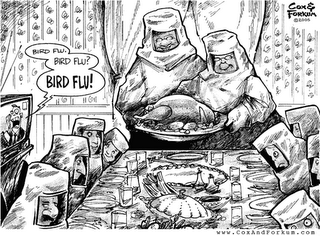
Funny how the bird flu scare utterly disappeared. Maybe scare was the only real part:
I am totally unconcerned about bird flu. I am not denying its existence or that it has in fact killed some people. I am just not buying into the pandemic hysteria.
I lump bird flu (or avian flu) right in with Alar, global warming, DDT, and other baseless, unscientific scare stories. Claton attempts to invoke fear by alluding to the plague, the 1918 flu, scarce groceries, and battles over food. But he offers no evidence that a pandemic may occur.
That was my 3/29/06 take on a Charlotte Observer scare story. Look how the bird flu InTrade futures have collapsed since then:
[Source: Intrade Contract: Bird flu (H5N1) to be confirmed in the USA ON/BEFORE 31st December 2006]
I remember several, including Dr. Dean of WBT, chastising Bush for not following the European lead by buying up massive amounts of Tamiflu. It generally pays to *not* follow the European lead.
Link posted by Andy @ 7:53 PM
Comments | Trackback
---------------------------------------------------
Well it is kind of true that bird flu does seem to have died down in terms of media attention, but the number of bird flu cases have risen exponentially this year. Check out the timeline of events - they haven't died down one bit, if anything, they've increased: http://birdfluthreat.org/bulletin/asia.php
And the mortality rate of H5N1 is increasing as well - 154 out of 258 cases have been fatal >> over 50% now!!More than 1 in two people who catch it might die.
----------------------------------
Sunday, November 26, 2006
Bird Flu Update
This is a cartoon from Cox & Forkum from a year ago:
Funny how the bird flu scare utterly disappeared. Maybe scare was the only real part:
I am totally unconcerned about bird flu. I am not denying its existence or that it has in fact killed some people. I am just not buying into the pandemic hysteria.
I lump bird flu (or avian flu) right in with Alar, global warming, DDT, and other baseless, unscientific scare stories. Claton attempts to invoke fear by alluding to the plague, the 1918 flu, scarce groceries, and battles over food. But he offers no evidence that a pandemic may occur.
That was my 3/29/06 take on a Charlotte Observer scare story. Look how the bird flu InTrade futures have collapsed since then:
[Source: Intrade Contract: Bird flu (H5N1) to be confirmed in the USA ON/BEFORE 31st December 2006]
I remember several, including Dr. Dean of WBT, chastising Bush for not following the European lead by buying up massive amounts of Tamiflu. It generally pays to *not* follow the European lead.
Link posted by Andy @ 7:53 PM
Comments | Trackback
---------------------------------------------------
Well it is kind of true that bird flu does seem to have died down in terms of media attention, but the number of bird flu cases have risen exponentially this year. Check out the timeline of events - they haven't died down one bit, if anything, they've increased: http://birdfluthreat.org/bulletin/asia.php
And the mortality rate of H5N1 is increasing as well - 154 out of 258 cases have been fatal >> over 50% now!!More than 1 in two people who catch it might die.
Wednesday, November 29, 2006
10 Concise Reasons That Make Bird Flu a Killer
Unless you’ve been resident in a cave hundreds of miles from civilisation, it’s probably clear by now that every nation on the surface of this planet is trying to prepare for this ‘global pandemic’ that experts are promising. It appears that there is no doubting if it might happen, but simply a matter of when it will happen - which unfortunately, could be tomorrow, or in fact be a hundred years into the future. And at this point in time, experts believe the bird flu is going to trigger it.
So omitting all the media’s figures and comments, this is what’s behind H5N1’s profile:
1. It’s capable of human infection – 258 cases to date.
2. In some instances, it’s been able to spread from person to person (see here). Should it get better at this, the population’s in trouble.
3. It’s getting less deadly and more infectious. By being less lethal, it has a greater chance of spreading from one patient to the next before the original patient dies. It’s getting more infectious.
4. Human bird flu infection is relatively young. Before 1997, it had never infected humans. To date, no fully tested human vaccine has been successfully produced.
5. There is a lack of effective antivirals. The best known medication against bird flu is Tamiflu and the world doesn’t have sufficient supplies of it if a pandemic hit soon.
6. Bird flu costs. It costs to prevent. It costs to prepare against. It would cost anything up to an estimated US$2 trillion if it causes a pandemic.
7. South-East Asia is the ideal breeding ground. Humans and chickens live close enough to significantly heighten chances of people contracting H5N1 and produce a novel virus.
8. The 1918 pandemic was believed to be a type of bird flu virus. There’s no reason why the next pandemic might not be – history often repeats itself.
9. Testing and medical facilities are inadequate where cases occur. Cases usually occur where humans have contact with live poultry – usually on farms or in markets. Testing means samples are sent away to a sizeable laboratory.
10. Lack of awareness. Some people, believe it or not, are 100% ignorant that H5N1 exists. If a pandemic hits but no one knows it’s hit, prevention might be a tad difficult.
You and I are sitting on the crater of a volcano that’s pretty active…we just don’t know when it’s gonna blow. (Dr. David Nabarro, United Nations coordinator for Human and Avian Influenza.)
References >> Check out: http://birdfluthreat.org
Sunday, November 26, 2006
Bird Flu in An Eggshell
Everyone has heard about the Bird Flu Pandemic that is spreading around the world. It is effecting the world economy and could have a serious impact on our health.
In the United States Fast food restaurants are bracing themselves to stop serving chicken in replacement for fish or something that not remind people of the issue.
To learn more about the issue, here's a good place to get a good overview of the bird flu threat: BirdFluThreat.org: Global Avian Influenza Information
Subscribe to:
Posts (Atom)